Peter Olesen Satrum (1835-1911)
Peter Olesen Trætstykket (1835-1911), Ola Larsen Trætstykket (1797-?), Lars Pedersen (1759-1838)Sigrid Bårdsdatter Sætran (1835-1913)
Read also about Bård Pedersen Sætran, Sigrid's Father.Main Pages
ACTIONS
NOTES:
Who has the original picture of Peter and Sigrid? It looks like it was in a scrapbook and someone made a photocopy. I received this copy from Doris Shaler, daughter of Bartinus and Lina and grand-daughter of Peter and Sigrid.
Include a picture of Peter's trunk and how dad painted it. Take pictures of it empty from both inside and outside.
On the ships passenger list Peter used the name Sæthergjærdet, were they on yet another farm before they left for America?
Sigrid's name as "SECRE" : is it possible that the "C" is actually a "G". I have seen other documents where women named "SIGRID" were referred to as "SEGRE"
3/4 of my family comes from Skatval near
the Åsenfjord/Fættenfjord, but this 1/4 comes from Hegra
(Hegre). My great grandfather, Peter Satrum was married
to Sigrid Bårdsdatter Sætran in Norway. They had 2
children (Ole and Bartinus) there, emigrated to America in
1865 on the sailing ship Bergen
and had 2 more children (Gunnerius and Berit P.,who later
married Ole Sorte) in America.
Peter Satrum
Petter Trætstykke Sætran
(1835-1911)
Known in America as Peter Olsen, Peter Olesen, Peter Olson, Peter Satran, Peter Sætran, Peter Satrum.
Peter Olesen Trætstykket is recorded in SOLHEIM br.nr.3 as being on an old husmannplass named Trætstykket as was his father Ola Larsen (Ofstigjerdet). "Trætstykket" could literally be translated into "tree piece". The location of the rock foundation of a building is at the edge of an open field next to a forested area so a husmannplass referred to as "Trætstykket" (the piece next to the trees) could make sense. Ofstigjerdet is a reference to "Ofstigjerdet 3" near Hegra, Norway. Trætstykke is north and east of the Hegra church. There is a spectacular view of the Stjørdal river valley as you drive back to the Hegra church. Ofstigjerdet is south and west of Hegra church and across the Stjørdal river. After you leave the E-14 and cross the bridge, you turn right to get to the location of Ofstigjerdet. "-gjerdet" is one of those suffixes that usually indicates a cotter's place. It actually means "the fence", so it could mean it was a place beside or near a fence.
SAILING TO AMERICA ON THE "BERGEN"
Peter Satrum immigrated to America in 1865.
Peter Olesen, his wife, Sigrid, and 2 children, Ole and Bartinus, sailed on the bark (a type of sailing ship, the "bark" designation has to do with how the masts were mounted and the sails were rigged) "Bergen" on May 4, 1865 arriving in Quebec on July 6,1865 after a 2 month voyage. On the ship's manifest they were listed as Peter Olsen Sæthergjærdet 30 a farmer, Sirri Baardsdatter his wife 30, Ole Petersen his son 3 1/2 and Baardlinus Petersen his son 9 months. The ships manifest listed 181 adults, 111 children 1- 14 yrs, and 15 infants. The information on ages and spelling of names on the manifest was not totally correct. <See List>.
 <CLICK HERE>
or on the plat
image to see the location of Peter's farm in
1877 - it is outlined in red.on the image. Sigrid's father's, Bærd Pedersen
Sætran, farm is to the southwest outlined
in blue blue. Both
Peter and Bård are buried in the Minneola church
cemetery along with their wives . On the map,
the church is highlighted in green.
Peter's son, Bartinus, and his wife Lena are
buried there as well.
When looking at the proximity of the church to their
farms, you can see why this would have been a logical church
for them.
<CLICK HERE>
or on the plat
image to see the location of Peter's farm in
1877 - it is outlined in red.on the image. Sigrid's father's, Bærd Pedersen
Sætran, farm is to the southwest outlined
in blue blue. Both
Peter and Bård are buried in the Minneola church
cemetery along with their wives . On the map,
the church is highlighted in green.
Peter's son, Bartinus, and his wife Lena are
buried there as well.
When looking at the proximity of the church to their
farms, you can see why this would have been a logical church
for them.
Peter and Sigrid bought a farm in Minneola township, Goodhue County, Minnesota. We haven't determined the date of the purchase but according to the 1870 U.S. census they were on their farm. On the 1877 platt of Minneola township it is shown in in "Township 110 North, Range 16 West in the south east corner of Section 10 and belonging to "Peter Olson". . On the 1894 plat of Minneola township it is shown in in "Township 110 North, Range 16 West in the south east corner of Section 10 and belonging to "Ole P. Sorte". From the farm it was about a 4 mile ride by wagon or sleigh to Minneola Church where they were members. Peter sold the farm to Ole Sorte, husband of their daughter Berit and in the 1900 census Peter and Sigrid were listed as living on the farm but with Peter working for Ole. This may have been one of the situations where an older farmer "sells" the farm to a younger family member who then takes care of the older farmers for the rest of their lives.
Peter and Sigrid's graves are at the very north edge of the Minneola church's cemetery, a short distance west of the church. Also buried in that cemetery is their son Bartinus and his wife Mette Caroline Winge and their daughter Betsy (Berit) Sorte and her husband Ole.
TIMELINE
1853: Goodhue county was established March 5, 1853 and named in honor of James Madison Goodhue, who was the first printer and editor in Minnesota.
1854: Zumbrota was settled in 1854, organized in 1858 and received the name of its village platted in 1856 on the Zumbro river which flows across the southern part of the township. It was called "Riviere d'Embarras" by Pike in 1805-1806 adopting the name given it by French traders and voyageurs. The French name referred to obstruction of the river near its mouth by a natural raft of driftwood. Pronounced quickly and incompletely, with the French form and accent, as heard and written down by the English-speaking immigrants, this name "Riviere d'Embarras" was unrecognizably transformed into "Zumbro" which is used on a map of Minnesota in 1860. The village and township name adds a syllable, the Sioux suffix, "ta" meaning "at", "to", or "on", that is "the town on the Zumbro, being thus a compound from the French and Dakota languages.
1855: Minneola Township was settled in 1855 and organized on December 15, 1859. The name comes from the Dakota or Sioux Indian language, meaning "much water".
1861-1865: U.S. Civil War is fought.
1862: The "Sioux Massacre" killed 300-800 settlers (the actual number is not known) 90 miles west of where Peter and Sigrid settled, 3 years before they emmigrated. Click Here to view a picture of refugees fleeing from New Ulm to Mankato.

Also a picture from a paper of the time.

April 9, 1865: General Robert E. Lee surrendered to General Ulysses S. Grant
April 14, 1865: President Abraham Lincoln is assassinated.
May 14, 1865: Peter, Sigrid and their family sail from Trondheim on the bark Bergen.
July 6,1865: Peter, Sigrid and their family arrive in Quebec.
1869: In 1869 the village of Zumbrota had a population of 400 people. There were 4 or 5 stores and shops and 2 churches (Baptist and Congregational). Records for Goodhue County showed that there were 6,994 horses, 14,987 cattle, 185 mules, 7,381 sheep, 5,429 hogs, 282 carriages, 549 watches and 61 pianos. Minneola township where Peter and Sigrid lived had a post office.
1870 U. S. Census:
Peter Olsen , a farmer and his wife "Sarah" who was "keeping house" are listed as living in Minneola Township on a farm valued at $700 and having personal property worth $50. Living with them are their children: Ole, Bartinus and Betsy. All 5 were also listed in the 1880 U.S. census but the last name was recorded as "Oleson".
1877 Plat Book
In the 1877 plat book of Minneola township it is shown in in "Township 110 North, Range 16 West in the south east corner of Section 10 and belonging to "Peter Olson".
1880 U. S. Census:
Peter Oleson , a farmer and his wife "Sarah" who was "keeping house" are listed as living in Minneola Township. Living with them are their children: Ole, Bartinus and Betsy.
1894 Plat Book
In the 1894 plat book of Minneola township it is shown in in "Township 110 North, Range 16 West in the south east corner of Section 10 and belonging to "Ole P. Sorte".
1900 U. S. Census: (notice that the name "Satran" instead of Olsen is being used)
Peter and Sigrid's son-in-law Ole P. Sorte is listed as the "Head" of the household for the farm along with his wife, Beret. Also living there are Petter O. Satran a "farm laborer", father-in-law, Sigri P. Satran, mother-in-law, Petter P. Hemre, Ole's 20 year old brother who had immigrated in 1897, and Olga Satrum (Daughter of Bartinus Satrum and Metter Caroline Vinge) as a lodger.
1910 U. S. Census:
Peter and Sigrid were listed as still living with Ole P. Sorte and his wife Beret.
Sigrid Satrum
Sigrid Baardsdatter Sætran.
The location in Hegra, Norway, of Sigrid's childhood house is now just a grain field about 1/2 mile south and west of the Sætran farm. No buildings remain in that location. There is a field road that leads to this location from the main road that goes past the Sætran farm. To get to the Sætran farm, leave the E-14 road and turn north and go past the Hegra church. This is the same intersection where you would head south to Hegra Festning (Fortress).
In Minnesota, Peter and Sigrid's graves are at the very north edge of the Minneola cemetery in Minneola Township, Goodhue County, not too far west of the church. We have no explanation, but Sigrid's name is chiseled on her gravestone as "SECRE" Satrum. The closest guess any relative has offered is that spelling is close to the way a Norwegian at that time would say the name Sigrid. Minneola church records about Sigrid include a note (spelled as it was written in the book) "Anmerkninger": "Kom til am (abbreviation?) 1865.
Read more about Sigrid's father Bård Pedersen Sætran.
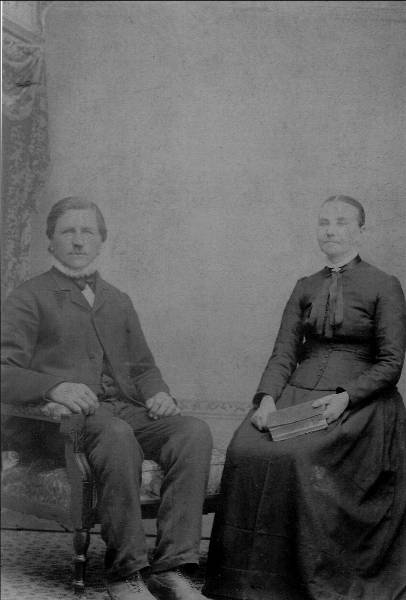 Petter Olesen Trætstykket 1835-1911 Sigrid Bårdsdatter Sætran 1835-1913 (Photo taken at Hunter Studio, Zumbrota, Minnesota) |
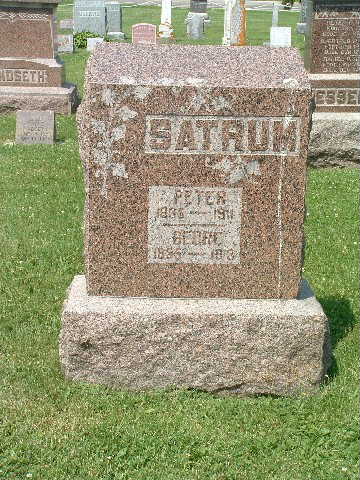 Peter and Sigrid Satrum Tombstone Minneola Church Goodhue County, Minnesota |
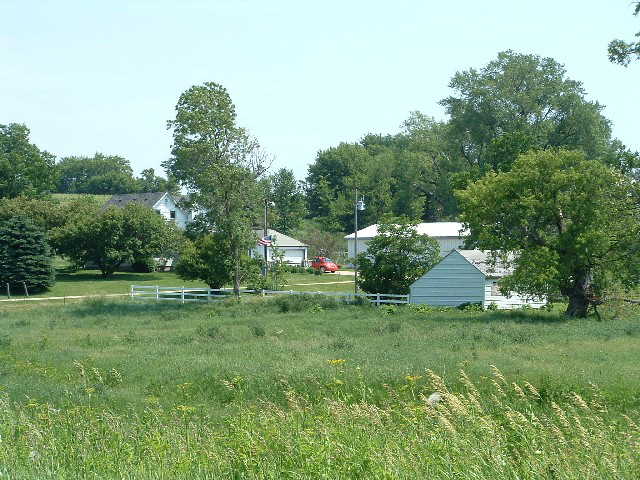 Current picture of the location of Peter Satrum's farm Minneola Township, Goodhue County, Minnesota |
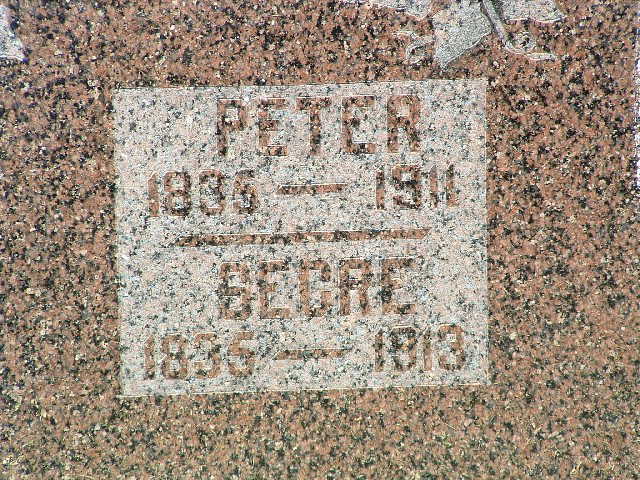 We initially thought
that the the spelling of Sigrid's name was "SECRE" but we have no
explanation of why this inscription would be on
her tombstone.
It is possible that
the "C" is actually a "G". The bottom of
the letter comes up a little farther than the to
of the right side of the letter. I have
seen other documents where women named "SIGRID"
were referred to as "SEGRE"
|
 Location of Traetstykket NE of Hegra Kirke |
 Steve at Traetstykket in 2019 |
 Petter Sætran Jon Satrum 2005 |
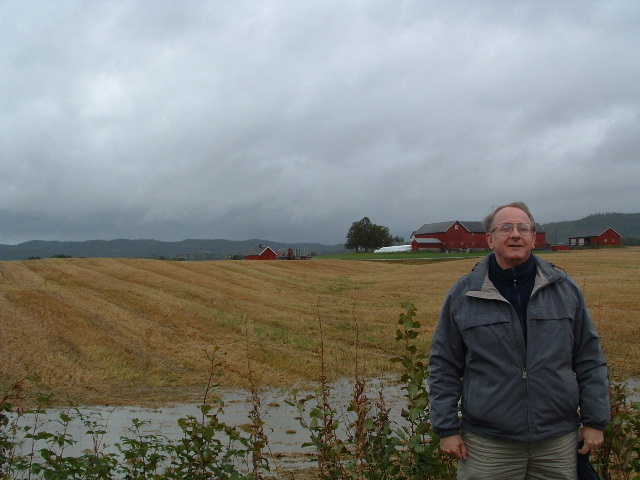 Location of Sigrid Sætran's home is the field behind me. The current Sætran farm is in the distance behind me |
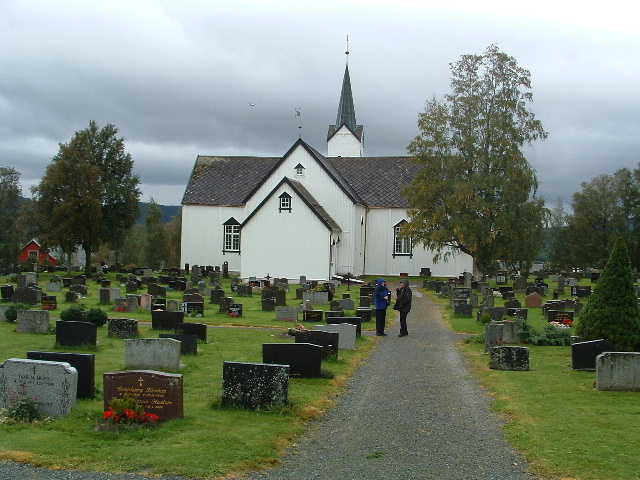 Hegra Church - 2005 The church is about 2 miles south of the Sætran farm |
 Saetran farm in 2005 |
Peter Satrum
Petter Trætstykke Sætran
(1835-1911)
Known in America as Peter Olsen, Peter Olesen, Peter Olson, Peter Satran, Peter Sætran, Peter Satrum.
Peter Olesen Trætstykket is recorded in SOLHEIM br.nr.3 as being on an old husmannplass named Trætstykket as was his father Ola Larsen (Ofstigjerdet). "Trætstykket" could literally be translated into "tree piece". The location of the rock foundation of a building is at the edge of an open field next to a forested area so a husmannplass referred to as "Trætstykket" (the piece next to the trees) could make sense. Ofstigjerdet is a reference to "Ofstigjerdet 3" near Hegra, Norway. Trætstykke is north and east of the Hegra church. There is a spectacular view of the Stjørdal river valley as you drive back to the Hegra church. Ofstigjerdet is south and west of Hegra church and across the Stjørdal river. After you leave the E-14 and cross the bridge, you turn right to get to the location of Ofstigjerdet. "-gjerdet" is one of those suffixes that usually indicates a cotter's place. It actually means "the fence", so it could mean it was a place beside or near a fence.
SAILING TO AMERICA ON THE "BERGEN"
Peter Satrum immigrated to America in 1865.
Peter Olesen, his wife, Sigrid, and 2 children, Ole and Bartinus, sailed on the bark (a type of sailing ship, the "bark" designation has to do with how the masts were mounted and the sails were rigged) "Bergen" on May 4, 1865 arriving in Quebec on July 6,1865 after a 2 month voyage. On the ship's manifest they were listed as Peter Olsen Sæthergjærdet 30 a farmer, Sirri Baardsdatter his wife 30, Ole Petersen his son 3 1/2 and Baardlinus Petersen his son 9 months. The ships manifest listed 181 adults, 111 children 1- 14 yrs, and 15 infants. The information on ages and spelling of names on the manifest was not totally correct. <See List>.
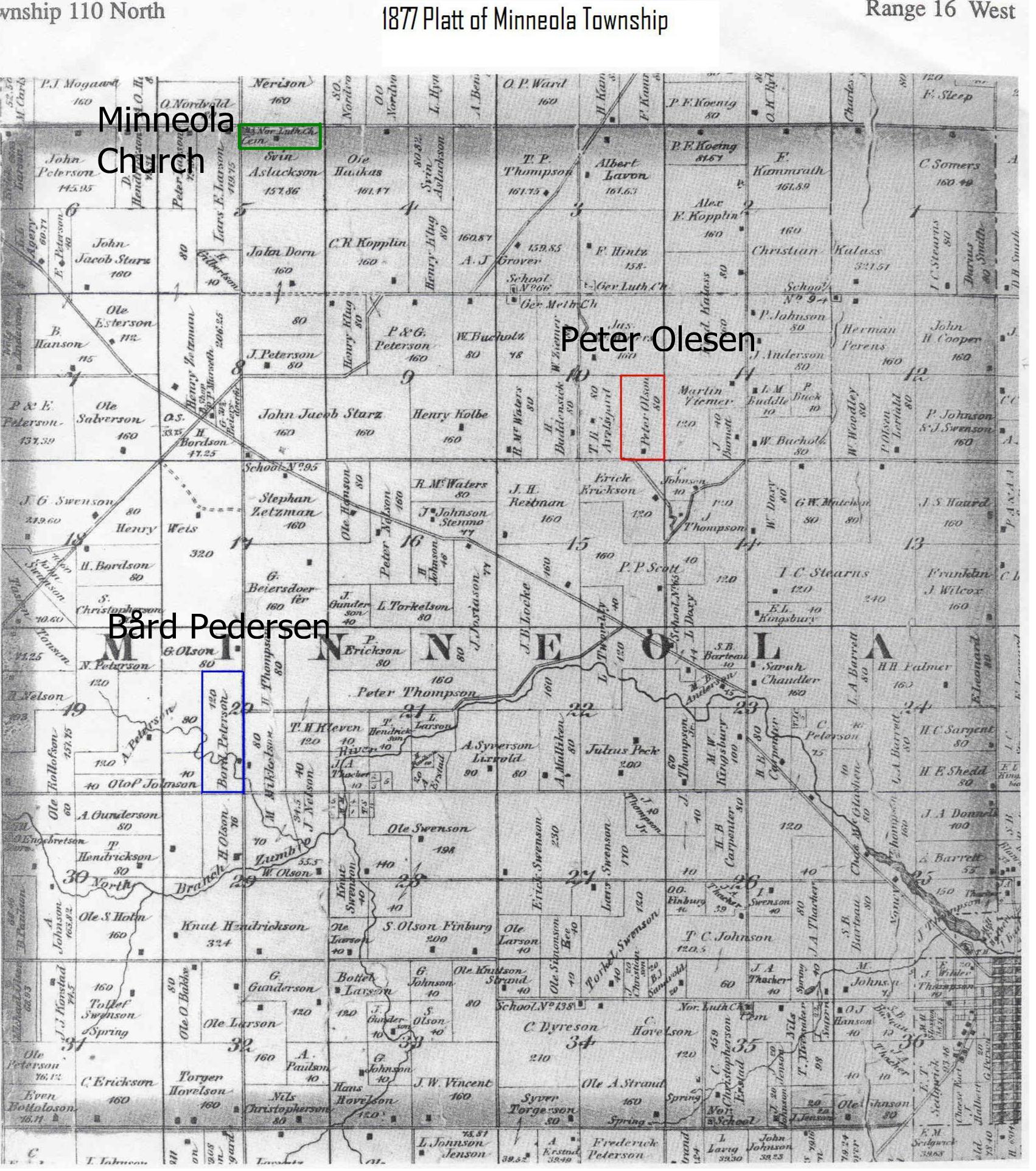 <CLICK HERE>
or on the plat
image to see the location of Peter's farm in
1877 - it is outlined in red.on the image. Sigrid's father's, Bærd Pedersen
Sætran, farm is to the southwest outlined
in blue blue. Both
Peter and Bård are buried in the Minneola church
cemetery along with their wives . On the map,
the church is highlighted in green.
Peter's son, Bartinus, and his wife Lena are
buried there as well.
When looking at the proximity of the church to their
farms, you can see why this would have been a logical church
for them.
<CLICK HERE>
or on the plat
image to see the location of Peter's farm in
1877 - it is outlined in red.on the image. Sigrid's father's, Bærd Pedersen
Sætran, farm is to the southwest outlined
in blue blue. Both
Peter and Bård are buried in the Minneola church
cemetery along with their wives . On the map,
the church is highlighted in green.
Peter's son, Bartinus, and his wife Lena are
buried there as well.
When looking at the proximity of the church to their
farms, you can see why this would have been a logical church
for them.Peter and Sigrid bought a farm in Minneola township, Goodhue County, Minnesota. We haven't determined the date of the purchase but according to the 1870 U.S. census they were on their farm. On the 1877 platt of Minneola township it is shown in in "Township 110 North, Range 16 West in the south east corner of Section 10 and belonging to "Peter Olson". . On the 1894 plat of Minneola township it is shown in in "Township 110 North, Range 16 West in the south east corner of Section 10 and belonging to "Ole P. Sorte". From the farm it was about a 4 mile ride by wagon or sleigh to Minneola Church where they were members. Peter sold the farm to Ole Sorte, husband of their daughter Berit and in the 1900 census Peter and Sigrid were listed as living on the farm but with Peter working for Ole. This may have been one of the situations where an older farmer "sells" the farm to a younger family member who then takes care of the older farmers for the rest of their lives.
Peter and Sigrid's graves are at the very north edge of the Minneola church's cemetery, a short distance west of the church. Also buried in that cemetery is their son Bartinus and his wife Mette Caroline Winge and their daughter Betsy (Berit) Sorte and her husband Ole.
TIMELINE
1853: Goodhue county was established March 5, 1853 and named in honor of James Madison Goodhue, who was the first printer and editor in Minnesota.
1854: Zumbrota was settled in 1854, organized in 1858 and received the name of its village platted in 1856 on the Zumbro river which flows across the southern part of the township. It was called "Riviere d'Embarras" by Pike in 1805-1806 adopting the name given it by French traders and voyageurs. The French name referred to obstruction of the river near its mouth by a natural raft of driftwood. Pronounced quickly and incompletely, with the French form and accent, as heard and written down by the English-speaking immigrants, this name "Riviere d'Embarras" was unrecognizably transformed into "Zumbro" which is used on a map of Minnesota in 1860. The village and township name adds a syllable, the Sioux suffix, "ta" meaning "at", "to", or "on", that is "the town on the Zumbro, being thus a compound from the French and Dakota languages.
1855: Minneola Township was settled in 1855 and organized on December 15, 1859. The name comes from the Dakota or Sioux Indian language, meaning "much water".
1861-1865: U.S. Civil War is fought.
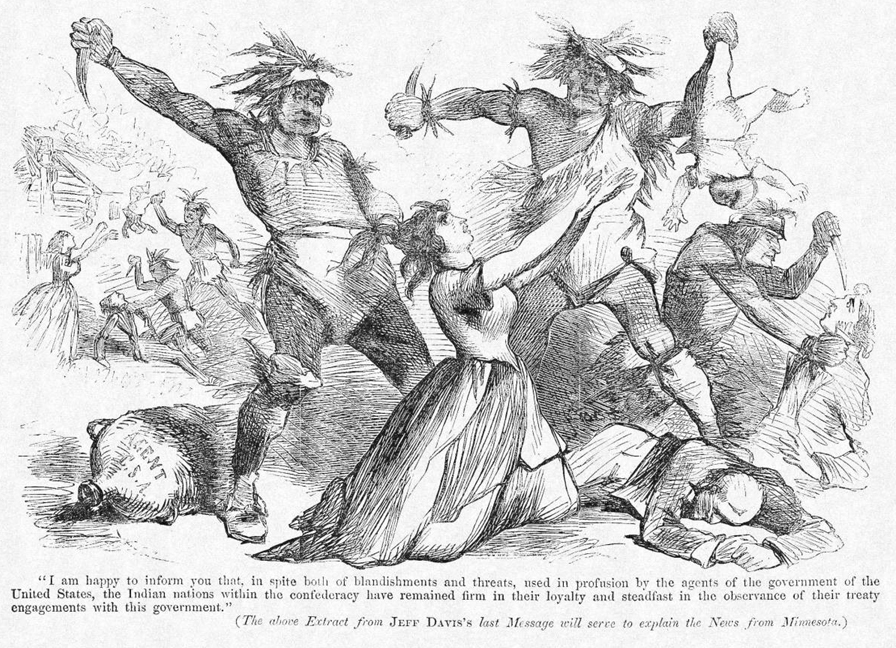
1862: The "Sioux Massacre" killed 300-800 settlers (the actual number is not known) 90 miles west of where Peter and Sigrid settled, 3 years before they emmigrated. Click Here to view a picture of refugees fleeing from New Ulm to Mankato.
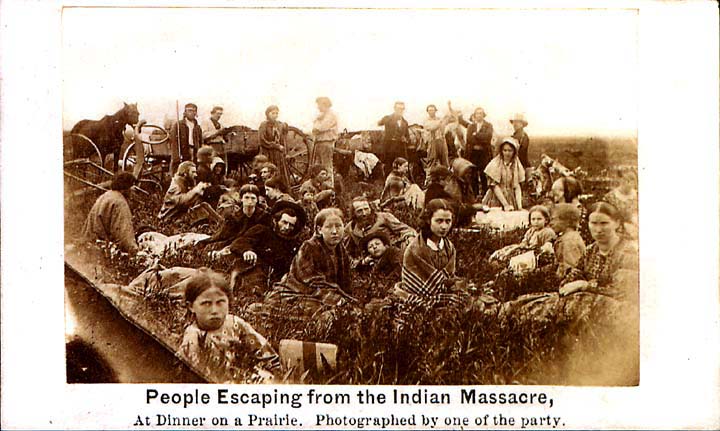
Also a picture from a paper of the time.
April 9, 1865: General Robert E. Lee surrendered to General Ulysses S. Grant
April 14, 1865: President Abraham Lincoln is assassinated.
May 14, 1865: Peter, Sigrid and their family sail from Trondheim on the bark Bergen.
July 6,1865: Peter, Sigrid and their family arrive in Quebec.
1869: In 1869 the village of Zumbrota had a population of 400 people. There were 4 or 5 stores and shops and 2 churches (Baptist and Congregational). Records for Goodhue County showed that there were 6,994 horses, 14,987 cattle, 185 mules, 7,381 sheep, 5,429 hogs, 282 carriages, 549 watches and 61 pianos. Minneola township where Peter and Sigrid lived had a post office.
1870 U. S. Census:
Peter Olsen , a farmer and his wife "Sarah" who was "keeping house" are listed as living in Minneola Township on a farm valued at $700 and having personal property worth $50. Living with them are their children: Ole, Bartinus and Betsy. All 5 were also listed in the 1880 U.S. census but the last name was recorded as "Oleson".
1877 Plat Book
In the 1877 plat book of Minneola township it is shown in in "Township 110 North, Range 16 West in the south east corner of Section 10 and belonging to "Peter Olson".
1880 U. S. Census:
Peter Oleson , a farmer and his wife "Sarah" who was "keeping house" are listed as living in Minneola Township. Living with them are their children: Ole, Bartinus and Betsy.
1894 Plat Book
In the 1894 plat book of Minneola township it is shown in in "Township 110 North, Range 16 West in the south east corner of Section 10 and belonging to "Ole P. Sorte".
1900 U. S. Census: (notice that the name "Satran" instead of Olsen is being used)
Peter and Sigrid's son-in-law Ole P. Sorte is listed as the "Head" of the household for the farm along with his wife, Beret. Also living there are Petter O. Satran a "farm laborer", father-in-law, Sigri P. Satran, mother-in-law, Petter P. Hemre, Ole's 20 year old brother who had immigrated in 1897, and Olga Satrum (Daughter of Bartinus Satrum and Metter Caroline Vinge) as a lodger.
1910 U. S. Census:
Peter and Sigrid were listed as still living with Ole P. Sorte and his wife Beret.
Sigrid Satrum
Sigrid Baardsdatter Sætran.
The location in Hegra, Norway, of Sigrid's childhood house is now just a grain field about 1/2 mile south and west of the Sætran farm. No buildings remain in that location. There is a field road that leads to this location from the main road that goes past the Sætran farm. To get to the Sætran farm, leave the E-14 road and turn north and go past the Hegra church. This is the same intersection where you would head south to Hegra Festning (Fortress).
In Minnesota, Peter and Sigrid's graves are at the very north edge of the Minneola cemetery in Minneola Township, Goodhue County, not too far west of the church. We have no explanation, but Sigrid's name is chiseled on her gravestone as "SECRE" Satrum. The closest guess any relative has offered is that spelling is close to the way a Norwegian at that time would say the name Sigrid. Minneola church records about Sigrid include a note (spelled as it was written in the book) "Anmerkninger": "Kom til am (abbreviation?) 1865.
Read more about Sigrid's father Bård Pedersen Sætran.
© Jon Satrum